Lighting Is The Half Of The Prompt Everyone Skips
Direction, quality, colour. Three decisions that do more for how an image reads than any adjective about mood.

Ask most people to improve an AI image and they'll rewrite the subject. Ask a photographer and they'll change the light.
Lighting is the difference between a product shot that looks like a catalogue page and one that looks like a phone snap on a kitchen counter. Same object, same lens, same framing. The light is doing all of it — and it's the slot most prompts leave completely empty, which means the model picks for you. Its default is usually flat, frontal and even, because that's what dominates training data.
Three decisions
Every lighting description answers three questions. Miss any one and you've left it to chance.
Direction — where is the light coming from? Quality — is it hard or soft? Colour — what temperature, and is there more than one?
Direction
The most consequential of the three, because it decides where the shadows fall and shadows are what create shape.
- Front lighting — flat, even, minimal shadow. Honest and a bit boring. Good for documentation and packshots where clarity beats drama.
- Side lighting — light from one side, shadow on the other. Reveals texture and form. The default choice for anything where the surface matters: skin, fabric, food, brushed metal.
- Backlighting / rim light — light behind the subject, edges glowing, front in shadow. Separates subject from background. Silhouettes if you push it.
- Top light — from directly above. Eye sockets go dark. Unflattering on people, excellent on food and flat-lay.
- Under light — from below. Reads as unnatural, because in the real world light almost never comes from the ground. Use deliberately or not at all.
side lighting from a window on the left, deep shadow on the right side of the face
Naming the source as well as the direction gives the model something physical to render — a window, a lamp, a fire, a screen — and it will usually be more consistent than an abstract direction alone.
Quality: hard or soft
Hard light comes from a small source relative to the subject. Sharp shadow edges, high contrast, strong definition. Midday sun, a bare bulb, a phone flash.
Soft light comes from a large source. Gradual shadow edges, gentle falloff. An overcast sky, a big window, a bounced studio light.
This is the single most useful lighting distinction and the vocabulary is simple:
hard directional light, sharp-edged shadows
soft diffused light, gradual falloff, no harsh shadows
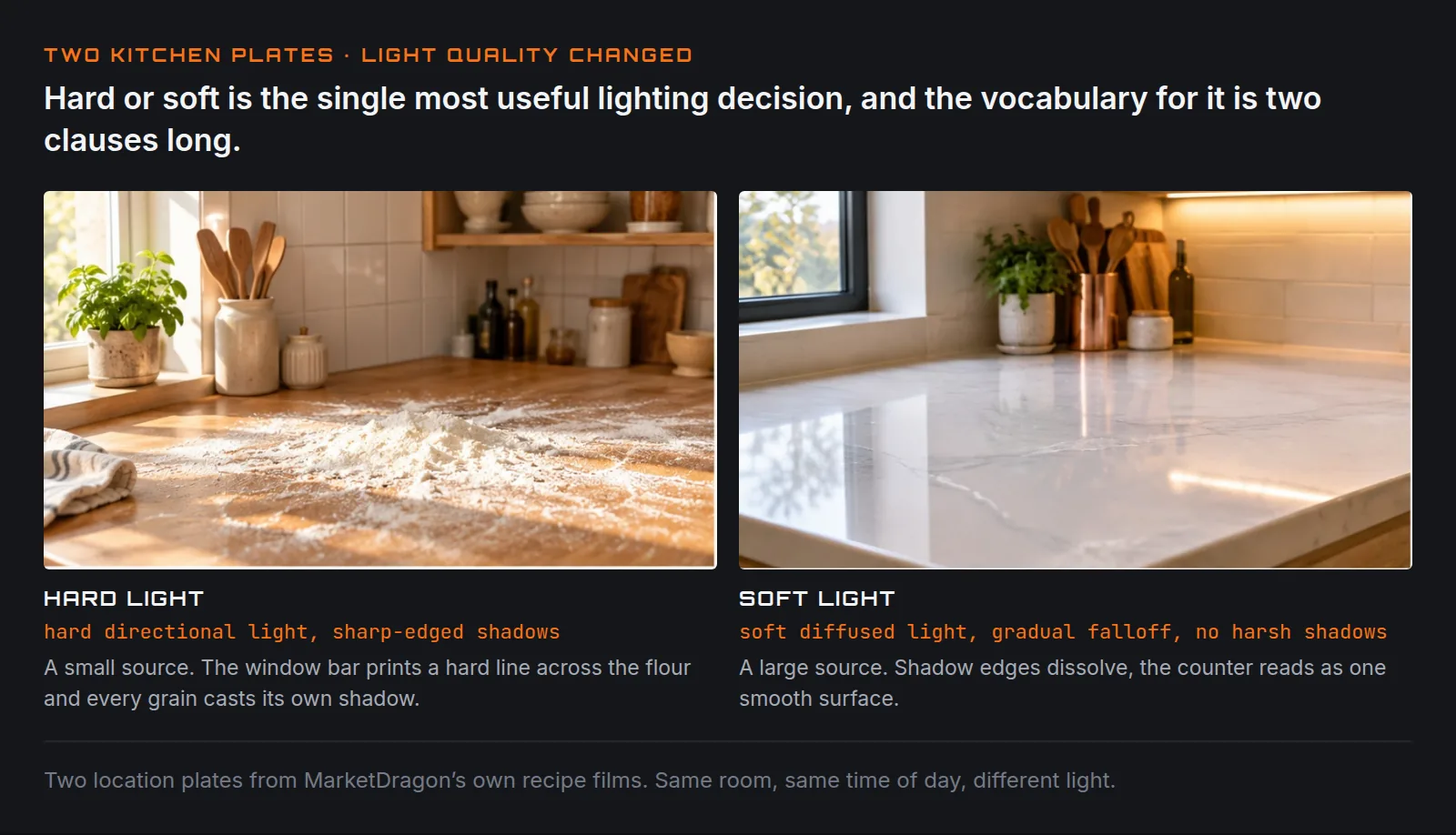
Hard light is dramatic and unforgiving — it shows every texture including the ones you didn't want. Soft light flatters and calms. Most "premium" product photography is soft light with one hard accent, not one or the other.
Colour
Two things: temperature, and whether there's more than one source.
Temperature in plain terms — warm reads as sunset, tungsten, candlelight, comfort. Cool reads as overcast, fluorescent, moonlight, clinical.
warm low sun, long shadows
cool overcast daylight, no direct sun
Mixed colour is where images get interesting and where most people never go. Real scenes rarely have one colour of light. A room at dusk has warm lamps inside and cool blue outside the window. A workshop has a cold overhead fluorescent and a warm work lamp.
cool blue light from the window, warm tungsten lamp on the desk, the two meeting across the subject's face
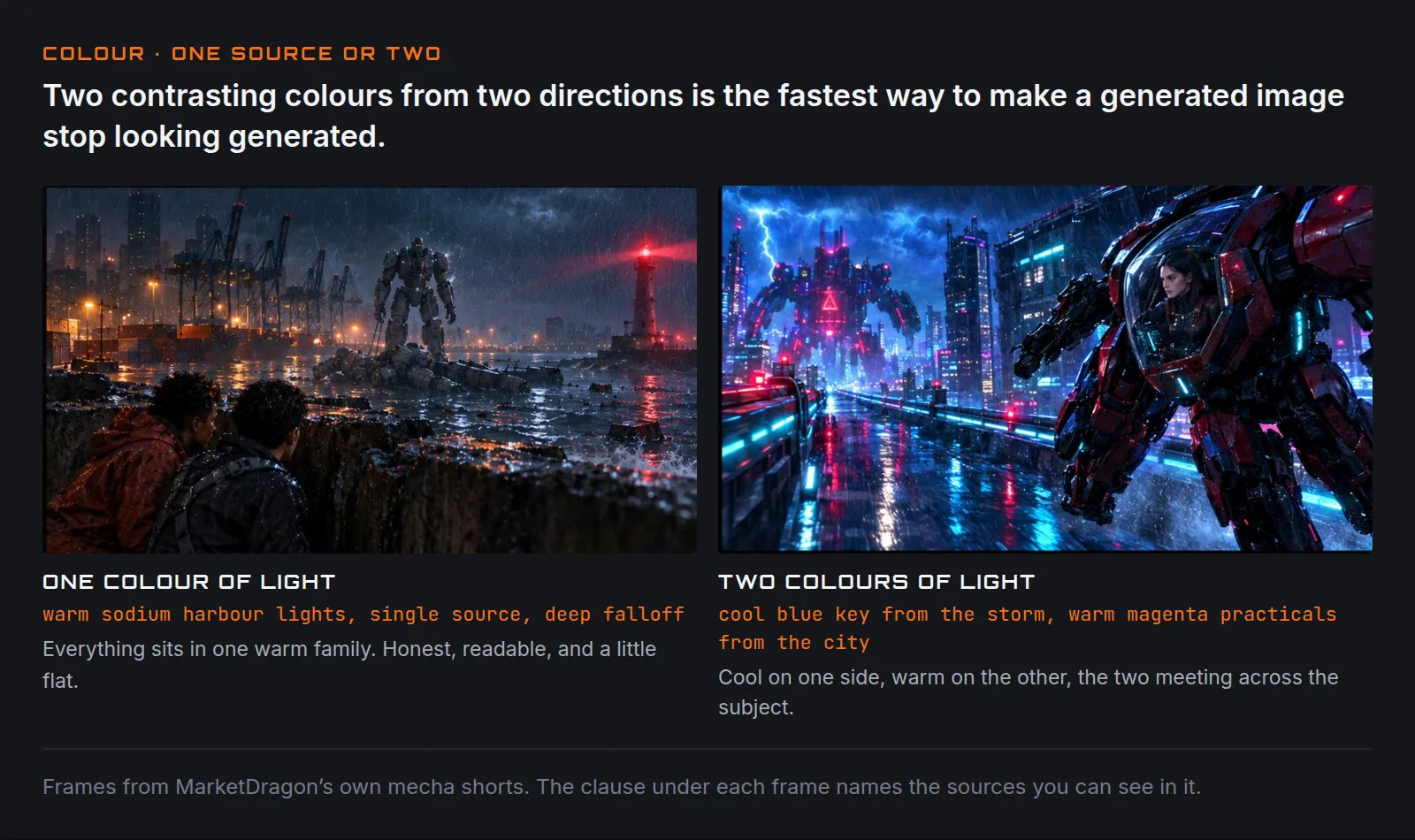
Two contrasting colours from two directions is the fastest way to make a generated image stop looking generated.
Say the source, not the feeling
The same principle that governs everything else in a prompt. "Moody lighting" has no geometry — moody could be a single hard rim light, or a dim room with a practical lamp, or shafts through a blind. Pick one.
| Vague | Specific |
|---|---|
| Dramatic lighting | Single hard light from the left, everything else in shadow |
| Moody | Dim room, one warm practical lamp, deep falloff into black |
| Bright and cheerful | Soft even daylight, high key, minimal shadow |
| Cinematic | Cool key from the window, warm rim from behind, deep shadow between |
| Professional | Large soft key at 45 degrees, subtle fill, no visible shadow edges |
The right column also has the advantage of reproducing. "Cinematic" gives you a different image every run because it isn't a description of anything.
Light and time of day are the same control
Naming a time is a shortcut that carries direction, quality and colour at once:
- Golden hour — low warm sun, long shadows, soft-ish, glowing edges
- Blue hour — after sunset, even cool light, no direct source, no hard shadow
- Midday — hard overhead, short dark shadows, high contrast
- Overcast — soft, directionless, low contrast, cool
Half your lighting work is done by writing late golden hour, sun low behind the subject and nothing else. If a time of day gets you close, use it, then adjust
the one thing that isn't right.
In video, light should usually hold still
A lighting change during a shot — a lamp switching on, a car's headlights sweeping past, clouds passing — is a real effect and video models will attempt it. But it costs you the same motion budget as camera movement or subject action, and it competes with them.
If the shot already has a camera move and a subject doing something, adding a lighting change is the third thing and something will be dropped. Pick which one carries the shot.
If you want the light steady, it's worth saying so:
lighting constant throughout, no change in exposure
A minimum viable lighting clause
If you add nothing else to your prompts after reading this, add one sentence with a direction and a quality:
soft light from a large window on the left
That's a source, a direction, and a quality in eight words, and it will do more for the image than another paragraph about the subject.
Keep reading
Same shelfShot Sizes, And Why "Close-Up" Isn't Specific Enough
Wide, medium, close-up, extreme close-up. How much of the subject is in frame is the single most reliable control you have over an AI shot.
Camera Angles That Change What A Shot Means
Eye level, low angle, high angle, Dutch. Four words that change the meaning of a shot more than any adjective you could add.
Camera Movement In Video Prompts: One Move Per Shot
Push in, pan, tilt, orbit, handheld. Naming the move is easy — the hard part is resisting the urge to ask for three of them at once.