Camera Angles That Change What A Shot Means
Eye level, low angle, high angle, Dutch. Four words that change the meaning of a shot more than any adjective you could add.

Most prompts describe what is in the shot. Almost none describe where the camera is. That single omission is why so much AI output looks flat and interchangeable — the model picks a default, and the default is almost always a neutral eye-level mid-shot, because that is what most training images are.
Camera angle is the cheapest edit you can make to a prompt. One phrase, and the same subject reads as powerful, vulnerable, or unsettling.
The four angles worth knowing
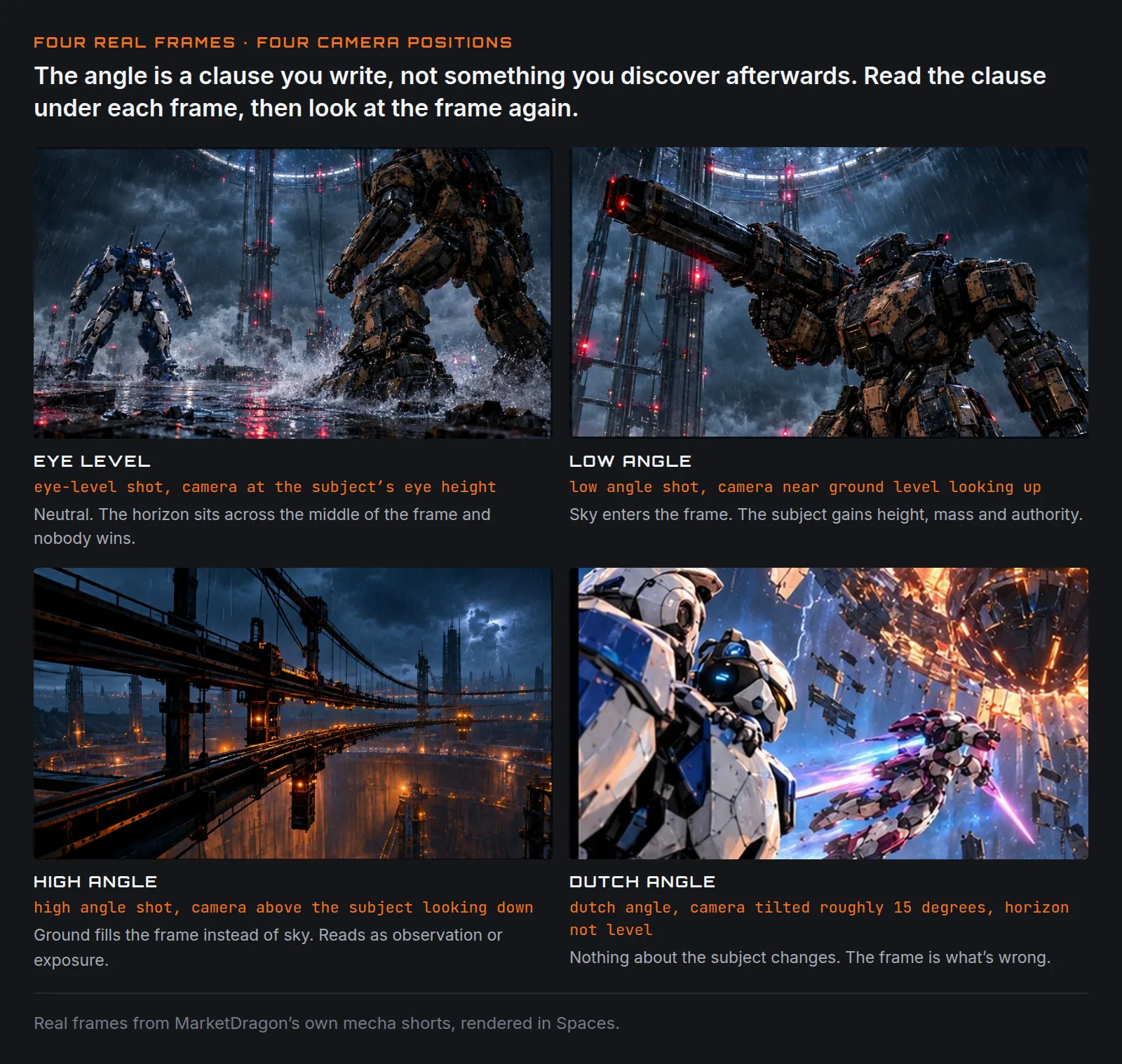
Eye level
The camera sits at the subject's eye height. Neutral, observational, no judgement. This is the default the model will fall back to, so you only need to write it when you want to be sure of it — for example when everything else in the prompt suggests drama and you specifically don't want the model reaching for a low angle.
eye-level shot, camera at the subject's eye height
Use it for interviews, product-in-hand shots, anything where you want the viewer to feel level with the subject rather than positioned against them.
Low angle
The camera sits below the subject, looking up. The subject gains height, mass and authority. Ceilings and sky enter the frame. Faces foreshorten — jawline and underside of the chin dominate, which is unflattering for portraits and excellent for villains.
low angle shot, camera near ground level looking up at the subject
This is the angle for hero reveals, architecture, anything that should feel bigger than the viewer. It is also the fastest way to make an ordinary object look monumental, which is why it is the workhorse of product advertising.
High angle
The camera sits above the subject, looking down. The subject loses power. Ground and floor fill the frame instead of sky. It reads as observation, vulnerability, or surveillance depending on how far up you go.
high angle shot, camera above the subject looking down
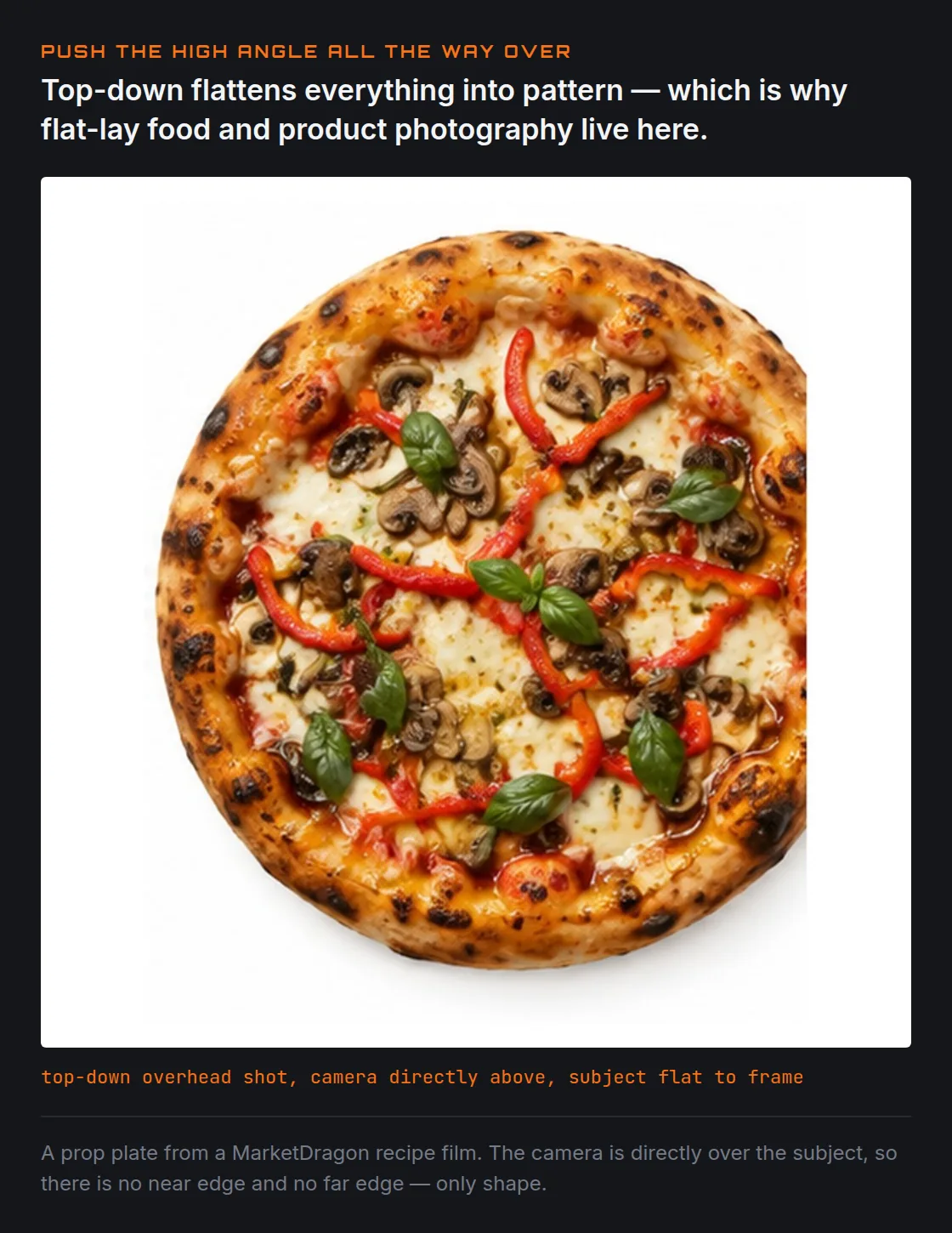
Push it far enough and you reach a top-down or overhead shot, where the camera is directly above. That is a different tool again — it flattens everything into pattern and is why flat-lay product photography and cooking videos live there.
top-down overhead shot, camera directly above, subject flat to frame
Dutch angle
The camera rolls on its axis so the horizon tilts. Nothing about the subject changes; the frame is wrong. It signals unease, disorientation, a world off its footing.
dutch angle, camera tilted roughly 15 degrees, horizon not level
Use sparingly. A Dutch angle in a corporate explainer reads as a mistake rather than a choice. Give it a degree of tilt in the prompt — left unspecified, models tend to either ignore it or roll the frame so far it looks like a bug.
Angle is not the same as height
These get conflated constantly and they are separate controls.
Height is where the camera is in space. Angle is where it's pointed.
A camera at ankle height pointed straight ahead is a low camera position with a level angle — you get a floor-level view without the looking-up distortion. A camera at eye height tilted down is a high angle from a normal height. The two combinations look nothing alike, and if you only write "low shot" you are leaving the choice to the model.
If it matters, write both:
camera positioned at knee height, angled slightly upward toward the subject's face
Say it in camera terms, not emotional ones
The instinct is to write the feeling: make him look powerful, make it feel unsettling. Models handle this inconsistently, because "powerful" has no geometry. Angle does.
Weak:
A dramatic, imposing shot of a chef in a kitchen
Strong:
Low angle shot of a chef in a stainless steel kitchen, camera near counter height looking up, chef filling the upper two-thirds of frame
The second version says the same thing in terms the model can execute. You will notice this is the same principle as the prompt formula generally: describe the observable, not the intention.
Angle in video is a starting position, not a fixed one
In a still image, the angle is the shot. In video, the angle you write is where the camera starts — and unless you also say what it does, the model may drift it. If you want the angle held, say so:
low angle shot, camera static, no movement, angle held throughout
If you want it to change, that is a camera move and it needs its own description. Combining an angle with a move in one careless phrase ("low angle sweeping shot") tends to produce a muddle, because you have given the model two instructions with no order between them. Write the start, then the move:
Opens on a low angle looking up at the tower. Camera slowly tilts down to street level over the shot.
A note on faces
Angle changes faces more than it changes anything else, and not in the direction people expect.
- Slightly above eye level is the flattering portrait angle. It's why phone cameras get held up. Jaw tightens, eyes open up.
- Below eye level foreshortens the chin and nostrils. Powerful, rarely attractive.
- Far above shrinks the subject and reads as pity or surveillance.
If you are generating people and they keep looking subtly wrong, angle is worth checking before you start rewriting the description of the person.
The short version
Add one of these to any prompt that currently has no camera in it:
| You want | Write |
|---|---|
| Neutral, observational | eye-level shot |
| Subject looks powerful | low angle shot, camera looking up |
| Subject looks vulnerable | high angle shot, camera looking down |
| Flat-lay, pattern, food | top-down overhead shot |
| Unease, tension | dutch angle, horizon tilted |
| Flattering portrait | camera slightly above eye level |
Angle is one of four things worth specifying about a camera. The others — shot size, lens, and movement — do different jobs, and they compose. A low angle close-up on a wide lens is a specific, repeatable look; "dramatic shot" is not.
Keep reading
Same shelfShot Sizes, And Why "Close-Up" Isn't Specific Enough
Wide, medium, close-up, extreme close-up. How much of the subject is in frame is the single most reliable control you have over an AI shot.
Lighting Is The Half Of The Prompt Everyone Skips
Direction, quality, colour. Three decisions that do more for how an image reads than any adjective about mood.
Camera Movement In Video Prompts: One Move Per Shot
Push in, pan, tilt, orbit, handheld. Naming the move is easy — the hard part is resisting the urge to ask for three of them at once.